Supine Spinal Twist
By Oliver Wakefield-SmithLast reviewed 2026-08-021 primary source cited→ AboutPearcy and Tibrewal (1984) used three-dimensional radiography in healthy men and measured about 2 degrees of axial rotation at each lumbar joint. So the lumbar spine itself turns very little, and this stretch should not be forced. The paper measured movement, not this stretch: none of the studies in our references tests the supine twist for back pain.
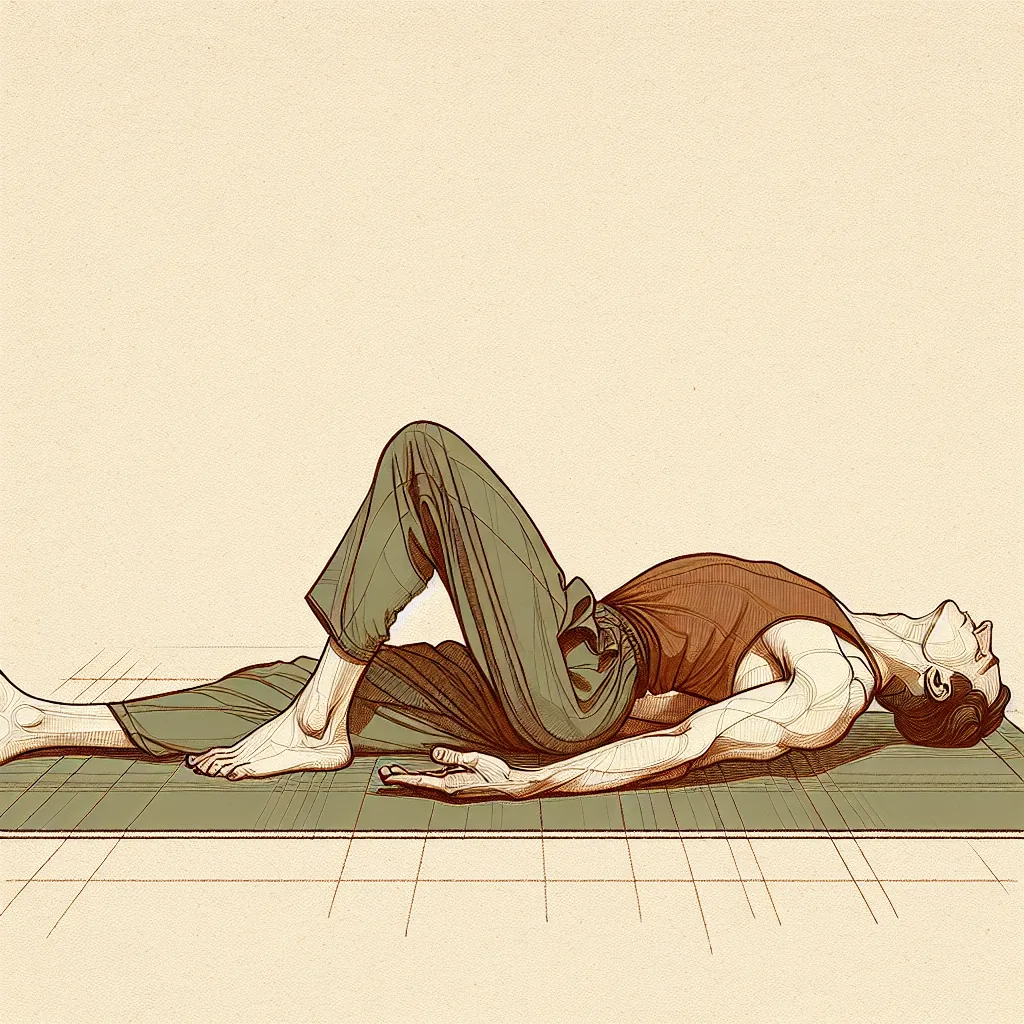
Illustration · follow the steps below for the actual technique
How to do it
- 1
Lie on your back, knees bent, feet on the floor
Knees bent
- 2
Lift your feet and stack your knees over your hips
Knees stacked
- 3
Let both knees fall gently to your right
Knees right
- 4
Keep both shoulders pressed into the floor
Shoulders flat
- 5
Turn your head to look left. Breathe deeply for 40 seconds, then switch
Look opposite
The evidence
Pearcy and Tibrewal (1984) used three-dimensional radiography in healthy men and measured about 2 degrees of axial rotation at each lumbar joint. So the lumbar spine itself turns very little, and this stretch should not be forced. The paper measured movement, not this stretch: none of the studies in our references tests the supine twist for back pain.
Citation: Pearcy MJ, Tibrewal SB (1984). Axial rotation and lateral bending in the normal lumbar spine measured by three-dimensional radiography. Spine · DOI: 10.1097/00007632-198409000-00008