What's actually going on in your lower back
You don't need to know every muscle by name. You do need to know which structures are in play when your back hurts, because the right stretch depends on which one is causing the pain.
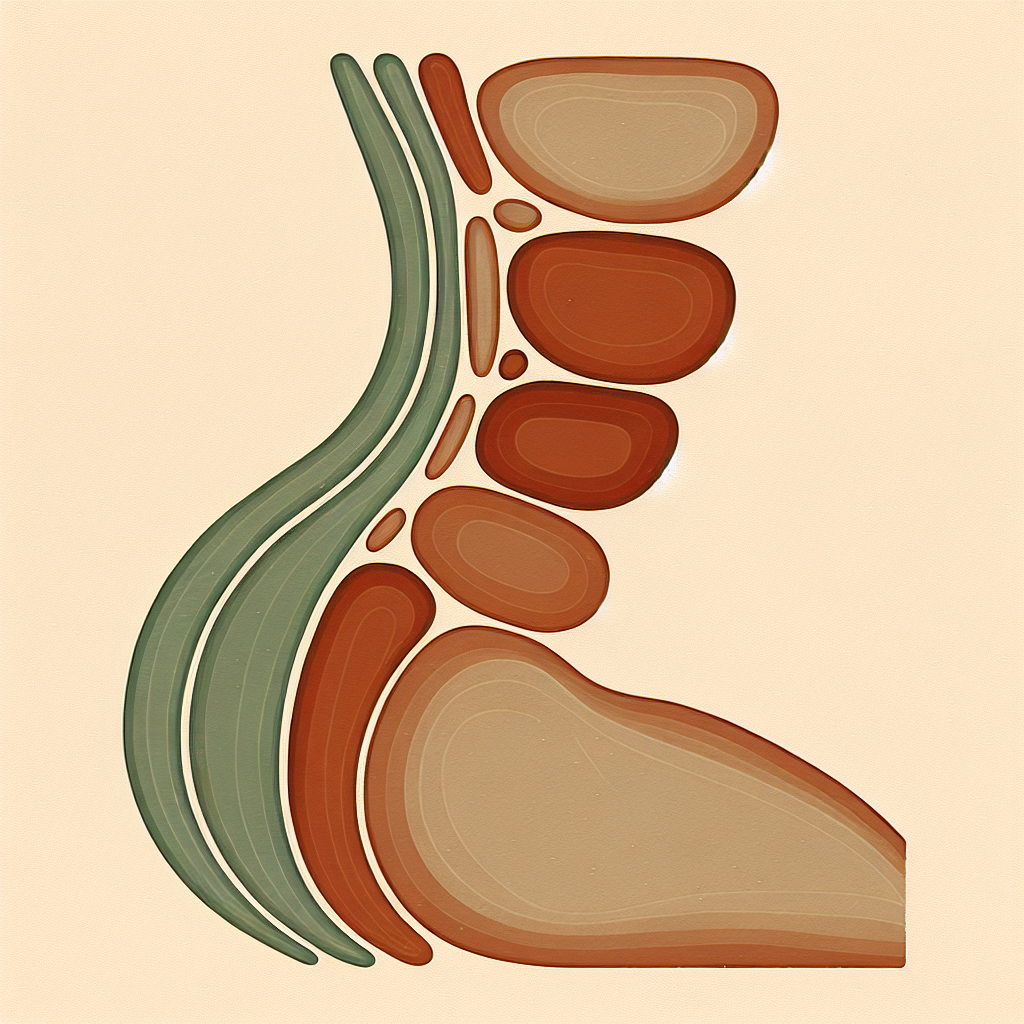
The lumbar spine: five vertebrae doing a lot of work
The lumbar spine is the five vertebrae between your ribs and your pelvis, labelled L1 through L5. They're the biggest vertebrae in the body because they carry the most load, every step you take, every weight you lift, every time you sit, the lumbar spine takes the force and transmits it through the sacrum into your pelvis.
Between each pair of vertebrae sits a disc (a tough fibrous outer ring with a gel-like centre) and a pair of facet joints (small joints at the back that limit rotation). The disc absorbs compression. The facets limit motion. When either system fails to do its job, the muscles around the spine, the paraspinals, the QL, the glutes, go into protective spasm. That spasm is what you feel as “back pain”.
The muscles that drive most non-specific back pain
Lumbar paraspinals (erector spinae)
Two thick muscle columns running either side of your spine, from sacrum to skull. They extend and stabilise the spine. When you bend forward all day at a desk, they lengthen under load; when you finally stand up, they cramp protectively. Most “morning stiffness” is paraspinal stiffness, not joint stiffness.
Quadratus lumborum (QL)
A deep muscle from your last rib to the top of your pelvis. It side-bends the spine and stabilises the pelvis. The QL is often the actual culprit when people complain of “one-sided” lower back pain or a pain that radiates into the hip. The supine spinal twist on this site specifically targets it.
Glutes (max, med, min)
The glutes are the largest muscle group in your body and the primary engine of hip extension. When they're weak (the dreaded “glute amnesia” of desk workers), the lumbar paraspinals overwork to compensate. That's why glute-bridge work shows up in a lower-back routine: re-teaching the glutes to fire takes load off the back.
Hip flexors (psoas, iliacus)
The psoas runs from the lumbar vertebrae down to the top of the femur. Tight hip flexors pull the lumbar spine into an exaggerated arch (anterior pelvic tilt), which jams the facet joints and irritates the paraspinals. That's why sitting all day causes back pain even though you weren't lifting anything.
Transverse abdominis (TVA)
The deep corset muscle that wraps the front and sides of the abdomen. Research by Hodges and Richardson (1996) showed that in people with chronic low back pain, the TVA fires too late to stabilise the spine before movement. The pelvic tilt on this site is the entry exercise for re-teaching it.
The load chain (why your toes affect your back)
The body is a closed kinetic chain. Tight ankles change your gait. A changed gait changes hip loading. Changed hip loading shifts pelvic alignment. A shifted pelvis changes the angle of the lumbar spine. The lumbar spine compensates, the paraspinals overwork, you wake up with a back that “just went”.
The practical implication: a complete lower-back routine includes glute activation (the engine), hip flexor lengthening (the antagonist of glute extension), QL release (the muscle that gets handed the bill), and the lumbar work itself. The 5-minute beginner routine on this site covers all four in sequence.